Easy Butterfly Origami

My new book, Easy Butterfly Origami features 30 bold full-color patterns designed to accurately portray the dorsal and ventral sides of some of the most beautiful butterflies from around the world!

Origami Folding Tips

Origami, from the Japanese ori (to fold) and kami (paper), began in the 6th century when Buddhist monks introduced paper to Japan. The print-and-fold crafts and easy diagrams are designed to help children with fine motor skills, directions and hand eye coordination. Some basic origami folding tips:
  • Print and cut out patterns carefully.
  • Fold with clean, dry hands.
  • Follow the instructions. Study the diagrams and be patient.
  • Be precise: fold each crease well, flattening the creases by running your fingertip over the fold.
  • Folding the paper away from you is easier than folding towards you.
  • Be creative...use your origami on greeting cards, holiday decorations, table place cards and bookmarks.

Origami: Dollar Bill Bow Tie

Fold an origami Dollar Bill Bow Tie.


Difficulty: Easy

Directions:


1. Fold dollar bill back along the margin of Washington's portrait, as shown.


2. Fold forward, as shown.


3. Repeat on other end of dollar. Turn over.


4. Fold up to meet horizontal center, as shown.


5. Pull corner of bow tie out and down to open, as shown.


6. Repeat on other end.


7. Turn your bow tie around and repeat, folding up to horizontal center, as shown.


8. Open corners of bow tie by pulling out and down as before.


9. Turn over, and your origami Dollar Bill Bow Tie is finished!


©2009 Tammy Yee

Origami: Dollar Bill Aloha Shirt

Fold an origami Dollar Bill Aloha Shirt, as a graduation gift or just for fun.


Difficulty: Easy

Directions:


1. Turning your dollar bill over, fold one end to meet the horizontal center line.


2. Repeat horizontal fold on other side.


3. Fold 1/4 inch back on one end; this will be the collar.


4. Fold diagonally as shown, and repeat on other side, to finish the collar.


5. At opposite end of collar, fold 1/2 inch forward, as shown. This will be the "sleeves."


6. Fold one corner of the sleeve down, diagonally, as shown. Repeat on other side.


7. Open up the diagonal folds. Note how the sleeves are creased as shown.


8. Open up the sleeve on one side, along the diagonal crease, as shown.


9. Repeat on other side.


10. Fold body of shirt up, to just beneath the collar.


11. Tuck the body of the shirt under the collar, as shown, and your origami Dollar Bill Aloha Shirt is finished!


©2009 Tammy Yee

Crafts: Dollar Bill Rose, for Graduations and Celebrations

Give your favorite graduate a bouquet of roses he or she will appreciate.


Difficutly: Easy

Materials:
  • 3 bills per rose, in any denomination
  • Floral wire
  • Floral tape (optional

Directions:
1. Pinch dollar bill in center, as shown.


2. Secure with floral wire. (I've used a pipe cleaner for this demonstration.)


3. Repeat until you have three sets of "petals."


4. Nestle the petals inside one another, arrange, and twist together.


5. Using a pencil or a paintbrush handle, curl the tips of the petals, as shown.


6. Optional: Finish off by wrapping green floral tape around the wire, add a ribbon and silk leaves for pizazz.


©2009 Tammy Yee

Science: The Aurora Borealis

Astronaut Don Pettit creates a time lapse video of the Aurora Borealis from the International Space Station. NPR Science Friday, April 10, 2009.


What is the Aurora Borealis?
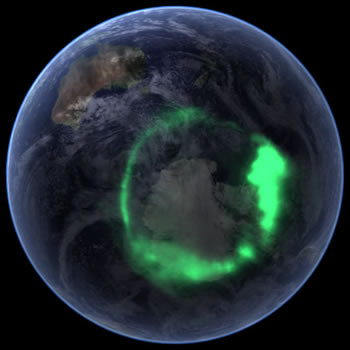
Auroras are brilliant curtains of light most often seen in the polar regions. In the north they are called the Aurora Borealis (Aurora, after the Roman Goddess of Dawn, and Borealis, Greek for "north wind") and are most often seen from September to October and from March to April. In the south they are called the Aurora Australis (Australis, Latin for "south"), and can best be viewed from September to May.

The Aurora Australis over Antarctica, as seen from space.


What causes auroras?
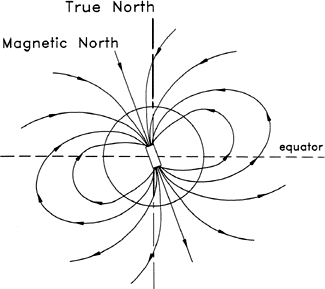
Molten iron swirling deep within the Earth creates a magnetic field around the planet. If you can imagine a giant bar magnet inside the Earth, the ends are where the magnetic north and south (or positive and negative) poles would be. Magnetism is a force which attracts magnetized objects, just as a magnet attracts paperclips or iron filings. The Earth's magnetic field draws particles along magnetic field lines, toward the magnetic poles:


When solar winds bombard the Earth with ions, these charged particles move along the magnetic field lines toward the magnetic poles. When these particles strike our atmosphere, they erupt in spectacular displays of light, what we call the auroras.


Photo by Senior Airman Joshua Strang, U.S. Air Force (from Wikipedia).


Some fun facts about the Aurora:
  • Solar winds drive particles toward the Earth at about a million miles per hour. It takes 40 hours for these particles to strike the Earth's atmosphere.
  • The Earth's magnetosphere shields us from these particles; if not for this shield, life on Earth would be very different.
  • The colors of the aurora result when charged particles from the sun strike atoms in our atmosphere:
    * Green - oxygen, up to 150 miles in altitude
    * Red - oxygen, above 150 miles in altitude
    * Blue - nitrogen, up to 60 miles in altitude
    * Purple/violet - nitrogen, above 60 miles in altitude


You can learn more about auroras and the Earth's magnetic field at Windows to the Universe.

©2009 Tammy Yee

Coloring: Count and Color Creatures of the Reef


Print Count and Color Creatures of the Reef


Can you count and find:
1 Dolphin
2 Monk seals
3 Humuhumunukunukuapua'a (Triggerfish)
4 Eagle rays
5 Hammerhead sharks
6 Urchins
7 Crabs
8 Moorish idols
9 Seashells
And...

10 Milletseed butterflyfish?


Print Count and Color Creatures of the Reef

©2009 Tammy Yee


Copyright ©2009 Tammy Yee
All rights reserved. No portion of this web site may be reproduced without prior written consent.