Easy Butterfly Origami

My new book, Easy Butterfly Origami features 30 bold full-color patterns designed to accurately portray the dorsal and ventral sides of some of the most beautiful butterflies from around the world!

Origami Folding Tips

Origami, from the Japanese ori (to fold) and kami (paper), began in the 6th century when Buddhist monks introduced paper to Japan. The print-and-fold crafts and easy diagrams are designed to help children with fine motor skills, directions and hand eye coordination. Some basic origami folding tips:
  • Print and cut out patterns carefully.
  • Fold with clean, dry hands.
  • Follow the instructions. Study the diagrams and be patient.
  • Be precise: fold each crease well, flattening the creases by running your fingertip over the fold.
  • Folding the paper away from you is easier than folding towards you.
  • Be creative...use your origami on greeting cards, holiday decorations, table place cards and bookmarks.

Sea Otter Awareness!


Fold an Origami Sea Otter to commemorate Sea Otter Awareness Week!


How much do you know about those lovable, fur-faced acrobats twisting and diving in kelp beds?

Sea otters are one of the few mammals, aside from primates (monkeys and apes), to use tools. Floating on the surface of the water, they sometimes place a rock on their chest, using it as a hard surface to smash open shelled food like clams and abalone. Have you ever wondered how otters carry all that stuff to the surface? In their armpits, in loose skin folds! Try that with an urchin--better yet, don't try it.


These resourceful animals even use kelp as an anchor, wrapping themselves in the long fronds to keep from floating away while they rest. Kelp also makes a great babysitter. Mom leashes her pup in kelp, letting it bob on the surface as she hunts for food, never having to worry about paying the sitter.

This year will mark the 7th annual Sea Otter Awareness Week. All across the United States, Canada, Australia and the Netherlands, aquariums are sponsoring events to teach the public about these endangered creatures.

For more information about otters and a list of events, visit the Defenders of Wildlife website, http://www.defenders.org.

Sea otter facts you "otter" know:

  1. Size
    Sea otters are the largest member of the weasel family, but the smallest of all marine mammal. Males grow as large as 5 feet while the average length of adult females is 4 feet. Full grown otters weigh as much as an average 9 to 10 year old child. Baby otters weigh only 5 lbs at birth!
  2. In the wild they live up to 10 to 12 years of age; however, they can live as long as 25 years.
  3. Because they have no blubber, sea otters keep warm with their dense fur. They have the thickest, finest fur of any mammal, with up to 1 million hairs per square inch, and they need to keep clean to stay warm. This is why otters are so vulnerable to oil spills.
  4. Sea otters' webbed hind paws are ideal for a life spent almost entirely in the water.
  5. A Big Appetite.
    Otters need to eat 25 to 30 percent of their weight every day just to stay warm. A 100 lb person would have to eat 100 quarter-pound burgers a day to keep up! Their diet consists mainly of clams, urchins, mussels, crabs and fish.
  6. Sea otters are social critters. They meet and play in groups of less than 10, to more than 100, called rafts. The moms and pups stay together in one group, separate from the males.
  7. Although moms usually give birth to one pup at a time, they sometimes give birth to twins. Unfortunately, only one pup will survive.


©2009 Tammy Yee

Computer Art for a Children's Book

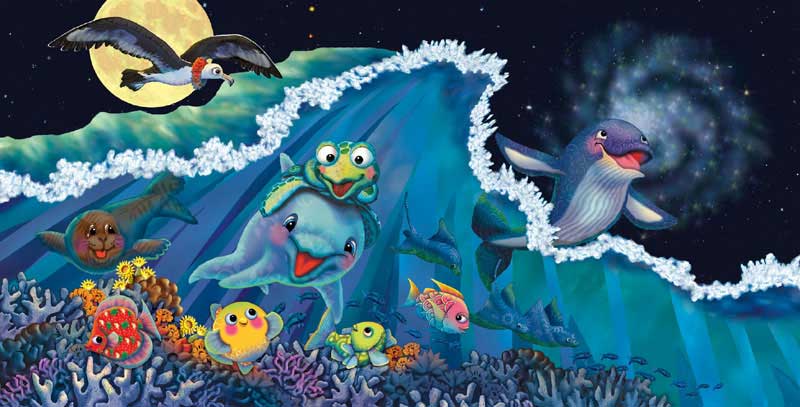
Here's the finished work, from a book I wrote and illustrated, Whales' Tails and Turtle Trails:


©2009 Tammy Yee
All rights reserved.

Creating a computerized children's book illustration of an albatross

One of the characters in a book I wrote and illustrated, "Whales' Tails and Turtle Trails" features a Laysan Albatross (Moli, or Phoebastria immutabilis). These magnificent seabirds have an 80 inch wingspan, and breed in the Northwestern Hawaiian Islands.

Photo by Robert Schwemmer


1. Creating feathers using a general leaf template.


2. Next, grouping feathers together.


3. Now it's time to create a framework on which to paste my feathers.


4. Finally, colorizing the feather patterns completes the albatross.


5. Now that I've established the distinctive markings of the albatross, it's time to stylize the bird so that it's more appealing to children. I've enlarged the eyes and the beak, and have added a lei:


©2009 Tammy Yee
All rights reserved.

Ed Rondthaler: The nonsense of english spelling

Origami: Goldfish


Difficulty: Easy


Directions:


1. Print and cut out Origami Fish along outer solid lines.


2. With printed side facing up, fold vertically in half along center line.


3. Unfold and turn over, so that the printed side is facing down.
4. Fold diagonally as shown.
5. Repeat diagonal fold on the other side.


6. Your Fish Origami should be creased as illustrated.


7. Turn your paper over. With printed side down, fold along creases, forming a "tent" as illustrated.


8. Fold the dorsal (top) fin back, then up along solid lines.
Repeat with ventral (bottom) fin.


9. Turn your fish over. Fold top tail fin down, then up along solid lines as shown.
Repeat with bottom tail fin.


10. Turn your fish over and you're pau (done)!


©2009 Tammy Yee.
All rights reserved.

Origami Swallowtail Butterfly


Difficulty: Easy


Directions:


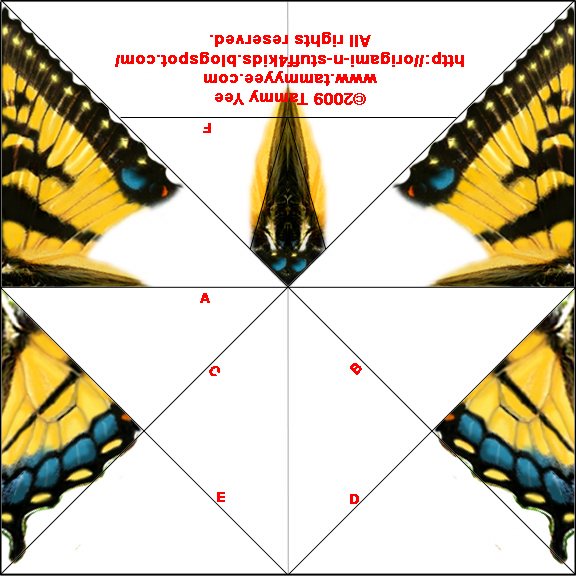
1. Print and cut out origami swallowtail butterfly.


For the next few steps, follow instructions to Monarch Butterfly Origami:
2a. With printed side facing down,
2b. Fold in half diagonally along B.
2c. Unfold and repeat the diagonal fold along C.


3a. With printed side facing up,
3b. Fold in half horizontally along A.
3c. Unfold. Your origami should be creased as illustrated.


4. Carefully fold along creases, forming a "tent" as illustrated.


5a. Fold the right "tent" corner up along D, as illustrated.
5b. Fold the left "tent" corner up along E, as illustrated.


6. Your Origami Swallowtail Butterfly should look like this:


7. Turn butterfly origami over, printed side down.


8a. Fold up along F. Note that corners will pull in to either side.
8b. Crease corners flat, as indicated by arrows.


9. Turn your origami butterfly over.


10a. Fold butterfly in half vertically, so wings are together.
10b. Crease one wing down, diagonally, to form body.
10b. Fold down the other wing, diagonally, as shown.


11. Open wings up. Your butterfly is done!


©2009 Tammy Yee
All rights reserved.

Origami: Butterfly

Here are two easy print-and-fold Origami Butterflies to decorate cards, use as bookmarkers and ornaments.

Monarch Butterfly Origami
Print a Monarch Butterfly
Pulelehua (Kamehameha Butterfly) Origami
Print a Kamehameha Butterfly


Difficulty: Easy


Directions:


1. Print and cut out origami butterfly.


2a. With printed side facing down,
2b. Fold in half along diagonal line.
2c. Unfold and repeat the diagonal fold on other side.


3a. With printed side facing up,
3b. Fold in half along horizontal line.
3c. Unfold. Your origami should be creased as illustrated.


4. Carefully fold along creases, forming a "tent" as illustrated.


5a. Fold the right "tent" corner up along line A, as illustrated.
5b. Fold the left "tent" corner up along line B, as illustrated.


6a. Turn butterfly origami over, printed side down.
6b. Fold down along line C.
6c. Pinch or crease in center as illustrated.


Your butterfly origami is ready to fly!

Pulelehua (Kamehameha Butterfly) Origami


©2009 Tammy Yee
All rights reserved.

Fascinating Frogs: Poison Dart Frog


Granular Poison Dart Frog, Costa Rica, by Sean Crane


The vibrant colors of these tiny frogs is a clear signal: Predators Beware!

Found in the hot and humid rainforests of Central and Latin America, these frogs have been used for centuries by Amerindian tribes in Columbia to coat the tips of blowgun darts and arrows. A steady diet of toxic insects, such as ants, is what makes these frogs lethal.

Some, like the Golden Poison Dart (or Arrow) Frog, are so deadly that the poison from a single frog, entering through cuts or contact with the mouth, can kill ten people!

There are more than 100 species of poison dart frogs. An inch to two and a half inches long, these dynamos hunt for spiders, ants and termites on the forest floor. When it is time to mate, the male attracts a female with a chorus of shrill chirps. After mating, the female lays her eggs, which are coated in thick gelatin to prevent them from drying out, on moist leaves.

When the eggs hatch, the male will carry his clutch of tadpoles down from the trees and deposit them into a small pond or the water-filled center of a bromeliad. There the tadpoles will remain until they're ready to sprout legs and morph into little frogs, ready to hop away on their own. Sometimes the female will return to feed her youngsters with unfertilized eggs.

Dad with his back full of tadpoles:


Print and fold an Origami Poison Dart Frog:


Frog Origami


Some really cool photos of poison dart frogs:


©2009 Tammy Yee
All rights reserved.


Copyright ©2009 Tammy Yee
All rights reserved. No portion of this web site may be reproduced without prior written consent.